10 pages, to download and share.
Download the PDFGoals are usually set for the medium to long term, and every company has its own method. These tips still apply to all managers and their teams. One principle first: team goals should always align with company objectives. And to make progress, check in on them regularly.
Setting clear goals and keeping track of them is key to the success of top teams and businesses.
How many objectives?
There is no magic number, but we recommend 3 to 5 objectives. More than that and you or your team may overextend, spread your efforts and lose focus. With only one or two, they are probably too high level or too consolidated, which makes them very hard to follow.
What is an objective?
An objective is a medium to long-term target that you or your team want to reach. Setting one means answering two questions:
- Where do I want to go? This is the objective itself.
- How and when do I get there? This is the objective’s description and its end date.
How to write a good objective
Keep the title short and ambitious: your team will remember it and draw inspiration from it. Express an endpoint, in tangible and unambiguous terms. An observer should be able to tell at once whether the objective has been achieved.
| Do | Don’t |
|---|---|
| “Ship feature B” | “Build a better product” |
| “Achieve X% growth on portfolio” | “Keep growing” |
| “Gain Y new users” | “Continue to do X” |
How to make an objective measurable
To describe an objective, set around three key results. Each one is a measurable milestone that, once reached, directly advances the objective. In other words, key results describe outcomes, not activities. That is what helps you reach the objective and track progress over time.
| Do | Don’t |
|---|---|
| “Publish customer support satisfaction levels before end of June” | “Analyse customer satisfaction” |
| “Share product A specifications with the Tech team before end of Q2” | “Contribute to product A”, “Work with Tech team” |
When to review goals
Regular reviews keep objectives alive and maximise the chances of reaching them. Reviewed only once a year, they are forgotten in between: it is as if you had no objectives at all.
The best approach is a quick review every month or quarter. It helps reconnect day-to-day work with the bigger picture. Don’t make it a big thing: just check where you and your team stand against your objectives.
If you hold weekly or bi-monthly 1:1s with your direct reports, talking about objectives once a month is a good way to step back, and keeps your 1:1s from becoming monotonous.
How to review objectives
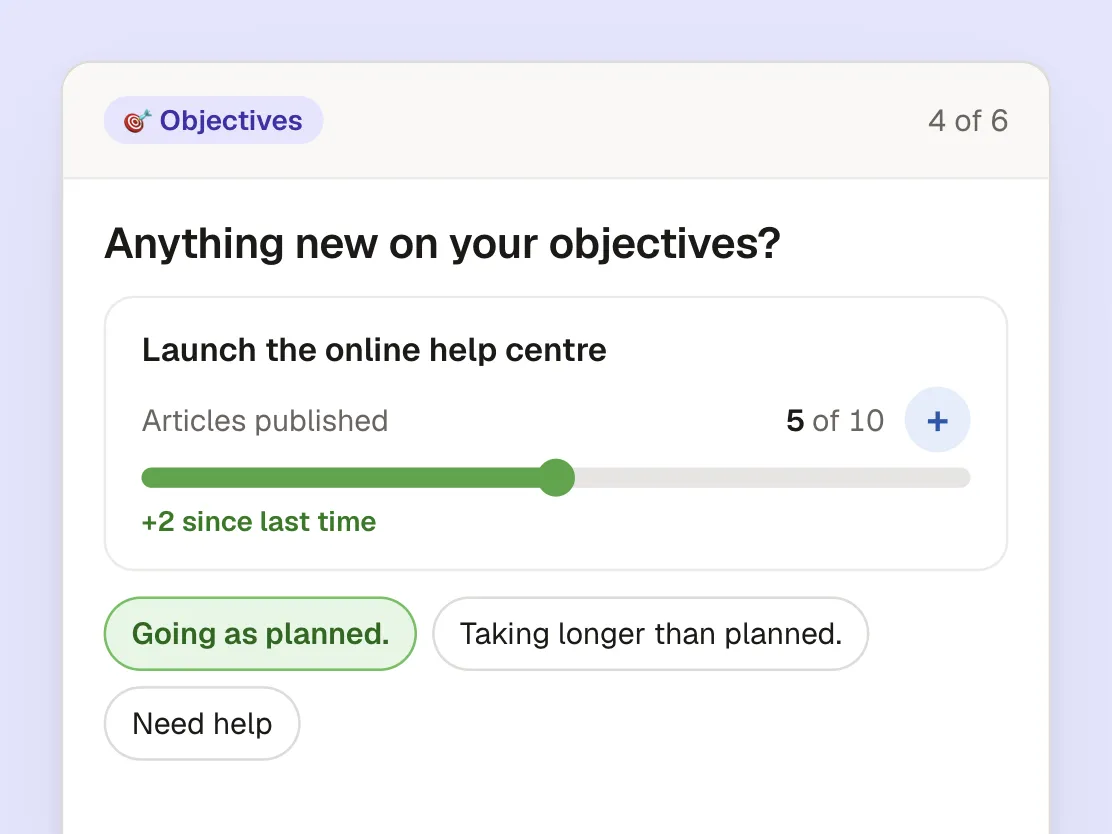
Give each objective a status update with a qualitative comment. The status measures your confidence in reaching the objective by its due date. We recommend three simple categories, for example: on track, behind, at risk. A status doesn’t say it all: the qualitative comment completes it and starts the conversation.
| Do | Don’t |
|---|---|
| “On track: we are 10% above our revenue target year-to-date and the pipeline for the rest of the year is strong” | “I’m confident we will reach our revenue target” |
In short
- The right number: 3 to 5 objectives at most for each team member.
- The definition: built together by the manager and team members.
- Each objective is clear, measurable, coherent with company goals and time-based.
- Frequent updates: a thorough review at least once a quarter, ideally a quick catch-up every month.
- Clear updates: a shared status or progress indicator, and a qualitative comment as a conversation starter.