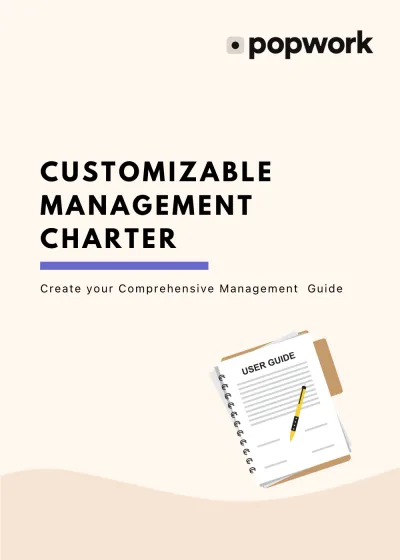
9 pages, to download and share.
Download the PDFManagement is the cornerstone of any organisation and plays a key role in employee engagement. A solid charter defines what the company expects of its managers. This template gives you a starting point to tailor to your company’s needs.
Our recommendations first, in five points: for each one, what to do and what to avoid.
1Introduce the management charter
Explain why a management charter matters and how it makes leadership more consistent and effective across the company. Avoid a charter that is overly complex or vague. It should be concise, specific and easy to understand.
2State your values and leadership principles
Give examples of values and principles that can serve as a foundation, and encourage people to adapt them to your company’s culture. Avoid copying other companies’ values. Your charter should be authentic.
3Describe managers’ responsibilities
List their key duties: communication, problem solving, people management and so on. Avoid burdening managers with unnecessary responsibilities. Be specific and realistic.
4Give guidance on communication and feedback
Give instructions on open communication, active listening and regular feedback. Don’t underestimate them: they are pivotal parts of leadership.
5Explain in practice how to apply the charter
Say how the charter will be implemented and integrated into the company culture. Avoid a charter that never gets put into practice. Make sure it is operational.
The template to customise
Here is a concrete example to adapt. Replace the passages in brackets.
Our vision of management and leadership
At [company name], we are driven by the principles of [bold, transparent and collaborative] leadership. This management charter sets out our values, principles and leadership expectations.
The role of managers
Managers hold a pivotal position in our organisation. They embody our core values, carry out the company’s strategy and are responsible for the working environment of their team members.
Our leadership values and principles
- [Courage]: we have the courage to make tough choices, speak candidly and stand up for what is right, even in the face of risks and difficulties.
- [Collaboration]: we foster collaboration, active listening and teamwork. We believe in the strength of the group.
- [Transparency]: we communicate openly and honestly, sharing important information with our team.
Managers’ tools
- One-to-one meetings: we put individual meetings at the heart of the relationship between managers and employees, as time dedicated to each employee.
- Objectives: a key management tool, to keep alive throughout the year to help employees set priorities and reach them.
- Development and coaching: employee development is discussed regularly, not in a single conversation a year.
- Continuous feedback: giving constructive feedback as often as possible helps people work better together and helps the team grow.
- Clear communication: communicating clearly and simply with your team, without withholding information, is an important part of a manager’s job.
Signed on [date]. [CEO’s signature]
Index: management values
Values to draw on for your own charter.
| Value | Description |
|---|---|
| Kindness | The manager listens to and cares about the well-being of team members, and creates a positive, respectful and supportive work environment. |
| Trust | The manager delegates effectively, believes in team members and builds a work environment based on mutual trust. |
| Courage | The manager makes tough decisions, speaks candidly and stands up for what is right, even when it involves risks or challenges. |
| Inspiring leadership | The manager leads, inspires and motivates the team, embodies the company’s values and sets the example. |
| Responsibility | The manager is accountable for the team’s results, values accountability, celebrates successes to build collective pride and, when things get difficult, finds solutions. |
| Transparency | The manager communicates openly and honestly, sharing important information with the team. |
| Integrity | The manager acts with integrity, respecting the company’s values and rules in all interactions and decisions. |
| Empathy | The manager is attuned to employees’ emotions, adapts their approach to people’s needs and offers support when needed. |
Index: management rituals
| Ritual | Description |
|---|---|
| 1:1 meetings | A one-to-one between manager and employee, weekly, every two weeks or monthly, to go over current topics, how the person feels and their workload. A chance to exchange regular feedback. |
| Objectives | Set 3 to 5 medium- or long-term objectives for each employee and track their progress regularly. |
| Development and coaching | Quarterly or half-yearly check-ins to step back on performance and achievements over the period. Also a chance to assess training needs. |
| Offsites | Occasional informal team events, seminars, offsites and team-building activities to strengthen cohesion and a sense of belonging. |
| Performance review | A yearly one-to-one between the manager and each employee on performance, ongoing projects and annual objectives. Also a chance to exchange feedback. |