69 pages, to download and share.
Download the PDFSeven chapters: setting objectives, coaching, communicating, planning the year’s rituals, giving feedback, running one-to-ones and getting performance reviews right.
1Set a clear direction for your team
Success comes from actions and decisions taken in the right direction: that is what objectives are for. They keep everyone focused on their mission and help prioritise daily work. They are a forward-looking management tool, not a meter to measure performance once it’s too late. At the end of the period, no one should be surprised whether they were met. The winning formula: clear objectives, co-built by manager and team member, coherent with company goals and time-based, then followed up.
How many objectives?
There’s no magic number, but we recommend 3 to 5. More spreads efforts thin; one or two may mean they are too high-level to follow.
What exactly is an objective?
An objective is a medium- to long-term target. It answers two questions: where do I want to go, then how and when do I get there (its description and end date).
How to write a good objective
A short, ambitious title that inspires, expressing an endpoint in tangible, unambiguous terms: an observer should be able to tell whether it has been achieved.
| Do | Don’t |
|---|---|
| “Ship feature B” | “Better product” |
| “Achieve X% growth on portfolio” | “Keep growing” |
| “Gain Y new users” | “Continue to do X” |
How to make an objective measurable
Give each objective around three key results: measurable milestones that directly advance it, describing outcomes, not activities.
| Do | Don’t |
|---|---|
| “Publish customer support satisfaction levels before the end of June” | “Analyse customer satisfaction” |
| “Share product A specifications with the tech team before Q2” | “Work with the tech team” |
| “Contribute to product A” |
When to review objectives
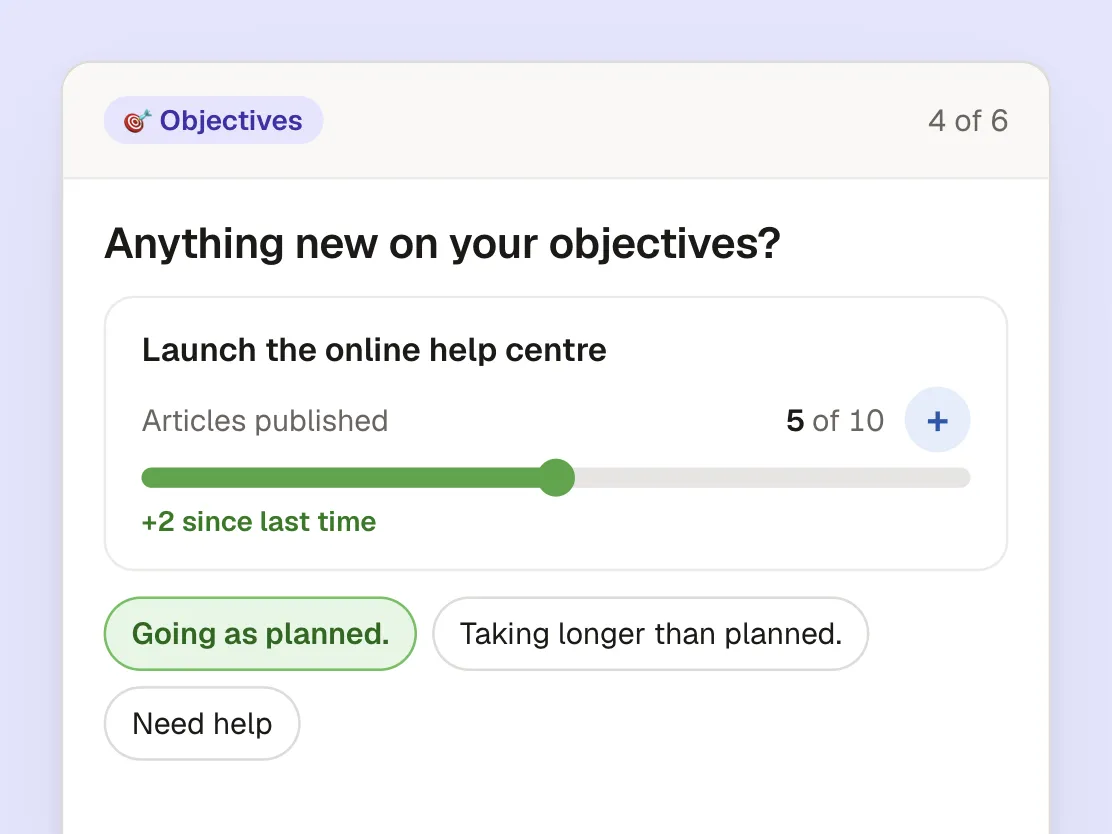
Reviewed once a year, objectives are forgotten in between: as if there were none. Do a thorough review at least once a quarter and, ideally, a quick, informal catch-up every month to reconnect day-to-day work with the bigger picture. In weekly one-to-ones, a monthly talk about objectives also helps step back and break the monotony.
How to review objectives
Give each objective a status measuring confidence in reaching it on time (on track, behind or at risk), plus a qualitative comment as a conversation starter, because a status doesn’t say it all.
| Do | Don’t |
|---|---|
| “On track: we are 10% above our revenue target year-to-date and the pipeline for the rest of the year is strong.” | “I’m confident we will reach our revenue target.” |
2Be a coach, not a boss
A boss gives directions; a coach asks questions. A boss “knows” what to do and demands action, which often means poor execution and little autonomy when things go wrong. A coach delegates the thinking too: they guide, help and decide when needed, but leave each person room to move forward. Trust is given by default, with a clear mandate. The keys: empathy and asking questions.
The importance of empathy
Empathy is understanding and sharing your team members’ feelings. The best coaches don’t judge and can challenge their own viewpoint. They master non-directive coaching: listening, questioning and withholding judgment. Less direction is highly energising.
The GROW model
The GROW model, created in the 1980s by Sir John Whitmore, is one of the best ways to get better at non-directive coaching. Its four steps give it its name. Easy to understand, it is harder to practice: it asks you to rethink your role as a leader.
1. Goal. First, establish exactly what the team member wants to accomplish, and more specifically what this discussion should achieve. It may sound strange at first, but it frames the conversation around the right goal and sets the tone.
- What do you want when you walk out the door that you don’t have now?
2. Reality. Next, ask them to describe their current reality: people often skip their starting point and miss information. Ask open questions (what, when, where, who), then get out of the way. As facts come out, the solution may emerge.
- What is happening now (what, who, when, and how often)?
- What is the effect or result of this?
- Have you already taken any steps toward this goal?
3. Options. People come for coaching when they feel stuck, with one option at best. Open, even naive, questions broaden the thinking. Then help them weigh benefits, downsides and risks.
- If anything was possible, what would you do?
- What would happen if you did nothing?
4. Willingness. Here managers step in more, as most people need guidance. A direct question should lead to an action plan consistent with the earlier steps; if parts are vague, go back. Get a commitment to specific actions, agree how often to review progress (daily, weekly, monthly) and set a date: it creates accountability and lets you change course if needed.
- What will you do?
Make coaching part of your management
Coaching at work is usually brief and improvised: use these moments to ask open questions rather than show and tell. Managers can no longer just command and control; they draw energy, creativity and learning out of their team, with an empathetic, non-directive mindset.
3Communicate effectively with your team
In short
- Why: good communication is the foundation of collaboration, engagement and performance.
- What: everything relevant to your team (the team’s activity, company news, information from upper management). Good news and bad news: don’t hide it.
- How: prepare, but don’t overthink it. Be clear and specific. Ask if there are questions or concerns, and if there are none, ask again. Use the right channel (email, meeting, conversation).
- When: sooner rather than later, as your team will appreciate hearing the news from you. Regularly and as often as needed: repetition reinforces your message.
- To whom: the same level of information for every team member.
Invest in your communication
A team can’t work well if it fails to communicate, with its manager and among its members: create the conditions for it. It is a skill, and every manager can improve with practice.
Choose what you communicate
Wait for big announcements and the team lacks visibility, with frustration or anxiety; message every event and they feel bombarded. Ask yourself: is this relevant to them? What if I don’t share it? If you are still unsure, under-communicating has more downside than over-communicating.
Prepare, but don’t overthink
Know precisely what message you want to convey: if it isn’t clear in your mind, it won’t be clear for them. Focus on one clear message, since people given too much remember only one or two things. Authenticity matters as much as preparation, if not more: being honest in what you say and write is the best way to be understood and received well. So don’t overthink how to say it.
Be concise, but not mysterious
Clear the first time, a message needs no re-explaining, and a few well-chosen words keep it simple. But too concise, and people must interpret, with a risk of misunderstanding.
Choose the right channel
There is no right or wrong channel; it depends on the message. Speaking lets you see reactions, read body language, get feedback and clear doubts at once. Writing lets you choose your words, gives a voice to those less inclined to speak in groups, and leaves something to refer back to. Use your judgment: a change or a reorganisation can’t be announced by email alone and needs explaining, while a new client can be celebrated by email. Either way, everyone should get the message at the same time. And don’t pile up channels: who wants a manager who tells you something, emails the same thing, then texts to ask if you read it?
Listen and challenge yourself
Give people time and space to react, speak out and ask questions. If they don’t react, ask them directly or invite them to rephrase what they understood, and clarify if needed. Your message may rest on personal, subjective assumptions you aren’t aware of. Ask yourself, “Do I sometimes filter what I have to say?”, and don’t let your assumptions keep you from sharing news or opportunities with your team.
Being clear and authentic, choosing an inclusive and suitable channel, and listening to each person’s reactions are the keys to communicating with impact.
4Set up your management rituals for the year
Management rituals are planned safe havens in the daily flow, each with its own pace, format and purpose. Scheduling them frees up time, gives the team autonomy and a safe space to speak up. No setup fits all, but the process is simple: plan in advance, explain, remain disciplined.
| Ritual | Purpose | Frequency |
|---|---|---|
| Check-ins and one-to-ones | Manage day-to-day | Weekly or biweekly |
| Team meeting | Facilitate collaboration | Weekly or biweekly |
| Objective setting and review | Review performance | Quarterly or twice a year |
| Career and training discussion | Support development | Yearly |
| Offsite, workshop | Share a vision and values | At least once a year |
Plan in advance
Choose rituals for each purpose, even if HR already sets some, and put the whole year on paper or in a spreadsheet. Put the next 12 months in everyone’s calendar: the sooner dates are blocked, the more effective the rituals.
Explain
Too often forgotten: why do rituals matter, why these ones, and what will each person get from them? At onboarding, in a one-to-one or a team meeting, share your convictions. If the team feels they matter to you, they will invest; if you seem to just follow HR, they become chores. Your vision as a leader begins here.
Remain disciplined
Be on time and never cancel. Through repetition, rituals build a shared identity and reduce anxiety; cancel them and the team hears that they don’t matter, or worse, that it doesn’t. Hold them even in tough periods: your team experiences your management through them first.
Check-ins and one-to-ones
The core ritual between a manager and each team member. They set the cadence, give regular checkpoints on objectives and priorities, and make room for real discussions about successes and challenges. In practice, they become the backbone of your management.
Team meetings
A quick stand-up or a deeper roundtable: a regular team forum aligns priorities, fosters collaboration and, over time, a sense of belonging. It also creates opportunities: “I’m meeting John from Company Z this week.” “Wait, I went to school with John, I can help you get that deal done.”
Objective setting and reviews
OKR or SMART, top-down or bottom-up, objectives drive the year. Set and formally review them at least twice a year, aiming for mutual buy-in. With one-to-ones to check in, share feedback both ways and sense morale, reviews become prepared conversations with no surprises, not feared meetings.
Career and training discussion
Leaders make their teams grow. Plan a formal career and growth discussion at least once a year. An hour on these topics helps you understand each person’s goals, how they align with the company’s, and how they could grow within the organisation. People who grow are more engaged and motivated, and spread positive behaviours through the team.
Share a vision and values
Sometimes it helps to take a day away from your usual work environment and step back: that is what offsites are for. At least once a year, plan a day to reinforce vision, values and bonding. Pick a quieter period and announce it early so everyone can be fully there. An agenda that looks back on the past period, looks ahead to the next, works on specific topics together and leaves time for fun usually does the trick.
5Give good and effective feedback
Done right, feedback builds confidence, increases performance, stimulates motivation and supports development. It takes many forms and is never easy to give.
In short
| Do | Don’t |
|---|---|
| Give feedback as often as possible | Give feedback only during annual reviews |
| Be specific, with simple and direct words | Hide behind vague and complex sentences |
| Focus on and build on strengths | Forget successes and achievements |
| Address issues with a constructive mindset | Sugarcoat and avoid negative feedback |
| Listen actively | Be the only one talking |
| Make sure your feedback is clear | Take it for granted that the message is understood |
| Make it actionable and future-focused | Focus on the past |
As often as possible
The more often you give feedback, the more natural it becomes for you and your team, and the more people ask for it spontaneously. It doesn’t have to be formal: give it in real time, anywhere, in check-ins, one-to-ones, in the moment or at the coffee machine. Don’t wait until the end of the year, and don’t make it sound dramatic.
Be specific
Feedback should be clear and actionable, never vague. Avoid complex sentences that confuse; use simple, direct, unambiguous words. Referring to recent situations and concrete facts is often the best way to be specific enough.
| Do | Don’t |
|---|---|
| “I noticed during our last team meeting that you are quick to criticise your colleagues but rarely praise them.” | “I think you are bringing negative energy to the team.” |
| “Congratulations on your presentation last week: you made it clear and inspiring.” | “You did a great job last week.” |
Be constructive and positive
Positive or negative, feedback should always be constructive: it builds confidence and draws on people’s best qualities. Focusing on strengths usually increases performance, while dwelling on weaknesses demotivates. But don’t avoid weaknesses if you want your team to improve and grow: present them as development opportunities.
| Do | Don’t |
|---|---|
| “You missed your sales targets last month: can we talk to understand what happened?” | “You are below your sales target: such poor performance is not acceptable.” |
Don’t just talk, listen
To see real change, make sure people understand the feedback and make it their own: ask them to react, whether they agree or not, or to rephrase what they heard. And listen to what they have to say. Feedback tells people what to change; listening actively makes them want to change. It makes a big difference.
Make it actionable
Good feedback looks forward. Focus on behaviours people can actually do something about. Too judgmental or focused on the past, and they become defensive, with little chance of change. Also identify concrete situations where they can practice what you shared.
| Do | Don’t |
|---|---|
| “I noticed some mistakes in your report last week: can you pay extra attention to the numbers before sending it next week?” | “You are not good with numbers.” |
6Run great one-to-one meetings
Skipped catch-ups, conversations drifting off-priority, actions forgotten from one meeting to the next? Time to rethink your one-to-ones: the most fundamental ritual between a manager and a team member, too often scheduled without thinking about why and how.
Set up the ritual
- Choose a cadence, every week or two, and stick to it.
- Choose a consistent length: 30, 45 or 60 minutes.
- Meet away from your desk: a meeting room, a quiet spot in the cafeteria, or a walk outside.
One-to-ones are a dedicated time for each person’s growth. To build trust, meet at the chosen cadence whether things are good or bad. When they are not going well, don’t shy away from a difficult conversation. When they are, it’s the perfect time to acknowledge successes, discuss how to go further and touch on career paths.
Set the agenda
A clear agenda helps both sides make the most of the conversation. Make it collaborative, so both can add their points, and keep the structure that works for you. Whatever it is, cover:
- a check-in on company and personal objectives;
- current priorities;
- what’s working well and recent achievements;
- current challenges and the support needed.
Add informative and administrative topics when needed: updates from management, vacations, expense reports.
During the meeting
- Be on time and give the meeting your full attention.
- Always start by asking how things are going at the moment.
- Stick to the agenda and the timing, as much as possible.
- Ask for feedback.
- Coach when necessary.
- Review action items and topics for the next one-to-one.
- Ask “What else?” You’ll be surprised what you can learn with this last open question.
Define next steps and follow up
This essential piece is often overlooked. With no next steps, or no follow-up on them, the meeting was nothing more than a light conversation. When wrapping up, confirm actions, topics to discuss further and agreements, for instance in a shared note, and assign each action to the team member or the manager. Take on action items yourself to remove hurdles for your team. At the next one-to-one, spend a minute or two reviewing previous items to make sure everything was done or covered.
Keep it fresh
The worst that can happen is for this ritual to become a chore: a boring, repetitive meeting that feels like going over a to-do list. To avoid it:
- Regularly check that you still have the right mindset: invest in the person’s growth and help them achieve more, rather than only collecting a status report.
- Mix things up with new, surprising questions: starting or ending with a thought-provoking question keeps the meeting a place for reflection, feedback and trust.
- Dedicate specific one-to-ones to career development.
With the right format, mindset, agenda and follow-up, and a willingness to keep things interesting, one-to-ones are the key ritual for trust, engagement, alignment and efficiency.
7Get performance reviews right
Often feared by team members and lengthy to prepare for managers, performance reviews are still the moment to look back on the year and step forward together. Your challenge: make them constructive for every team member.
Set expectations early
To review objectives well, you first need the right objectives to review. Setting expectations early, with mutual buy-in, is the best way to ensure good conditions. OKR or SMART help make objectives result-oriented, precise and tangible. Good objectives clearly answer the question: what does success look like? Answering it early helps you gauge performance objectively later. To co-build them, share the team’s objectives and ask each person to draft their own. Dedicate a one-to-one to the drafts, give your feedback, and ask for a final version that takes it into account. Review, adjust if needed, then formally share the objectives back.
Touch base often
An official review once a year doesn’t mean reviewing objectives only once a year, quite the contrary. Objectives are your team’s north star: they show how each person contributes to the team’s and company’s success, and people know their performance will be measured on them. Your role is to help them get there, by touching base often:
- How are they doing?
- Do they need more support?
- Are they facing hurdles you could help resolve?
- Are they prioritising the right initiatives to reach their goals?
Check in at least once a month. It doesn’t need to be formal or long, but knowing how each person is progressing, how confident they are and how you can help has a strong impact on focus and performance. These conversations also reconnect daily actions with longer-term goals: a team that understands its impact on the company is more engaged.
Prepare
Team members prepare their self-assessment: how they think they performed, their key achievements and challenges, and the resources they need to move forward (budget, headcount, training, but also more direction or managerial support). Managers draft an objective review: stick to performance on objectives, identify strengths and development areas, and always illustrate with examples.
Hold the conversation
Use the right tone and act as a coach, in four stages:
- Setting the stage: many people fear these reviews or feel uncomfortable. Introduce the meeting, insist that it is a two-way conversation, restate its goals and its benefits for both of you. The more it feels like a partnership, the better.
- Self-assessment: listen actively and refrain from speaking. When they have finished, rephrase what you understood. Only then move on.
- Manager feedback: start with successes and achievements, then identify gaps between expected and actual performance, and focus on the causes of underperformance.
- Conclusion and next steps.
Follow through
Follow-through turns the review into tangible actions with an impact on future performance:
- Put it on paper: write the review in a shared document; it becomes a reference for both of you.
- Craft solutions for underperformance: don’t just point out areas of development, work on them in coaching sessions.
- Adapt objectives: when co-building the next period’s objectives, take into account what worked and what didn’t.
- Follow up on the action plan: refer back to it during the year to check your progress.
Leaving the room, manager and team member should share the same view of the past period and of the best way forward. Don’t end the discussion without a plan and concrete next steps. The best reviews are conversations built on trust, and checking in on objectives regularly is the best way to avoid surprises.