26 pages, to download and share.
Download the PDFSetting up regular 1:1 meetings with your sales team is the best decision you can make as a sales leader. Done well, these meetings significantly improve a sales team’s performance. According to the Sales Management Association, companies that have adopted this ritual see their annual results climb by 16.7% on average.
Three conditions to get there:
- make it a recurring meeting and never cancel a 1:1;
- prepare your talking points in advance;
- adapt your questions to each team member.
Three benefits of 1:1 meetings
Build trust between manager and team members
1:1 meetings are a great way to strengthen the relationship and trust between managers and their people. And managers play an essential role in the engagement and performance of their teams.
Gain performance
What motivates a sales team above all is its performance and its ability to grow revenue. 1:1 meetings are first and foremost a performance booster: the Sales Management Association found that sales teams whose managers hold 1:1s with their reps see average revenue growth of 11%, rising to 17% in the SaaS sector. Coaching, clearing roadblocks, spotting best practices: the benefits are many.
Save time
A few minutes of your time can enhance the quality of your subordinate’s work for days.
This is how Andy Grove describes the impact of 1:1s. They let managers make excellent use of their time, provided the conversations are prepared, well run and followed up on.
1Establish a 1:1 culture
A true 1:1 culture makes these meetings a real ritual for your team: the 1:1 with each team member becomes an unmissable meeting. When a 1:1 doesn’t happen, it’s an issue for both the manager and the employee.
A real ritual needs clear rules. The ideal sales 1:1 is:
- weekly;
- 30 minutes long;
- not at your desk, somewhere you can really talk.
2Prepare the agenda
A 30-minute conversation is only worthwhile if you talk about the topics that matter, so preparation on both sides is essential. Keep the same structure week after week while leaving room for any topic, and have both of you define the agenda in advance: that is the truly transformative practice.
A 1:1 is not for reviewing reports or a task list you could have shared some other way. It is a privileged conversation between manager and team member on the topics that matter most. The agenda of a sales 1:1 is:
- prepared in advance;
- collaborative;
- built on a fixed structure.
3Adopt the right management posture
Respect the time slot
Stick to the planned length. Don’t run over, and don’t rush through it to save time: that would be deeply disrespectful to someone who took the time to prepare and may have things to share with you.
Never cancel a 1:1. If you have no choice, move it to another day the same week and let the person know as early as you can. A cancellation sends a very bad signal: they may conclude they are not a priority and don’t deserve your time.
Adopt the right attitude
During the 1:1, adopt an attitude that encourages the person to be open with you.
- Care. The 1:1 is not a performance evaluation. It is a tool to better support your sales reps, align on priorities and understand their coaching and training needs.
- Listen actively. Leave 80% of the speaking time to the other person. Take a real interest in what they say, react, take notes.
- Don’t cut them off, don’t monopolise the floor, and above all don’t take their remarks as personal attacks.
Create a space of trust
1:1 meetings are the cornerstone of the trusted relationship you build with each team member. As in any relationship of trust:
- be yourself and stay authentic;
- communicate transparently;
- listen actively and show empathy.
4Focus on the topics that matter
Go where the conversation creates value
Preparing 1:1s in advance sparks the most valuable conversations. Everyone’s time is precious: time spent internally is time spent not selling.
- Digging into a win or a closed deal brings out valuable lessons (good practices, positioning, effective objection handling) the whole team will benefit from.
- Taking time to discuss roadblocks allows effective coaching and lets the manager act as a resource: stepping in on a deal, approving a custom offer, and so on.
- Aligning on priorities for the coming period makes sure effort goes to the right areas and gives everyone more autonomy.
Ask the right follow-up questions
Preparing these meetings asynchronously and together keeps you from treating topics superficially. You escape the to-do list review syndrome and get an exchange both of you gain from. Ask the questions that let you dig, learn, challenge and coach: without them, the 1:1 does not contribute to continuous coaching.
- Don’t: 1:1s without preparation, to-do list reviews, improvised conversations without strong topics.
- Do: prepare 1:1s, tackle the important topics, coach through active listening and follow-up questions.
5Commit to next steps
Agree on what comes next
- At the end of the conversation, take stock of what was discussed, the issues raised and the solutions considered.
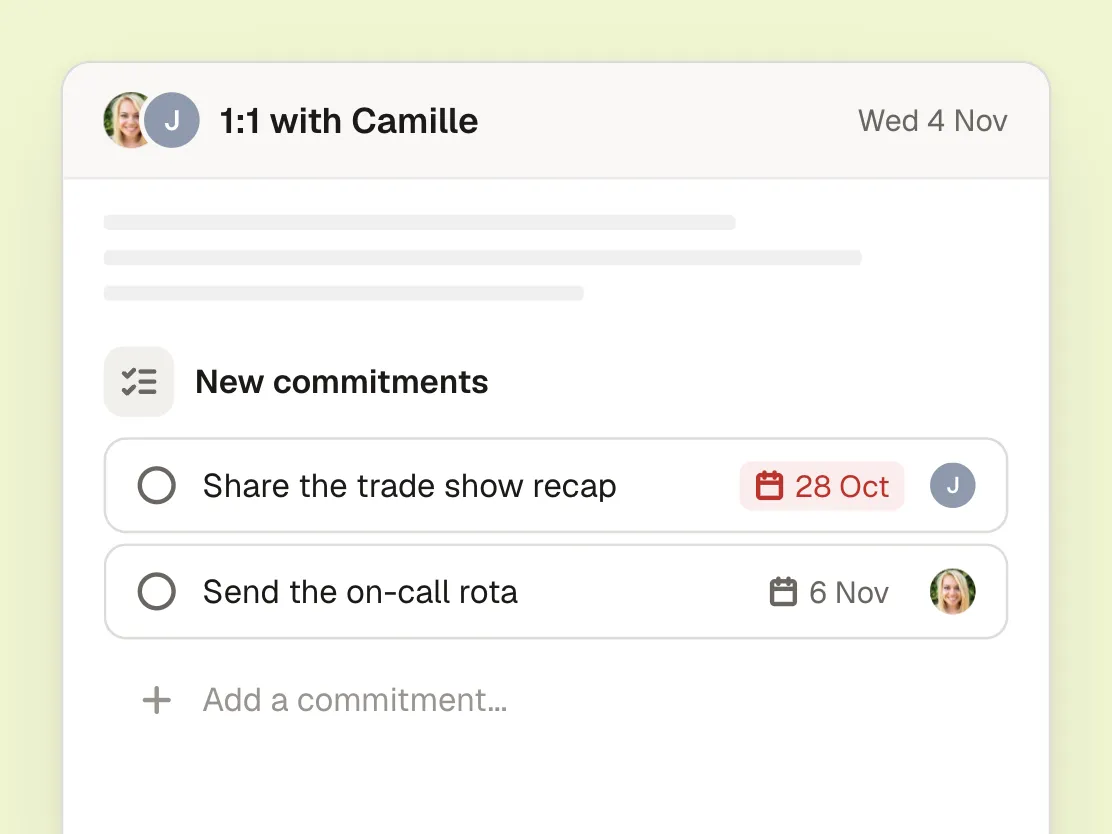
- Commit to actions that you will each own.
- Your sales reps must get something out of the 1:1. Avoid empty talk: think together about solutions to improve their sales performance, defuse a conflict or solve a problem.
- Then share a recap with the essential talking points and the agreed next steps.
Follow up week after week
Regular 1:1s let you follow your team’s performance over time. Take notes on what was discussed: at the next 1:1, you can come back to the roadblocks raised last time and measure progress on them. The conversations will deepen over time.
6Think long term
Connect short-term missions to the long-term vision
1:1 meetings are privileged moments to share your vision with your sales reps. Give them an overview of what is happening at company level and explain the impact they have individually. They will be more engaged and feel part of something bigger than their daily missions.
Help people grow and develop
These conversations are also a chance to help your reps develop their skills. Treat them as a career management tool: learn what people want and what their professional plans are, and help them get there. For example, help one of your top performers get a promotion or move into a position of responsibility, if that’s what they want. It is the best way to motivate them and push them to give their best.
Vary your questions
- Adapt the questions you ask to the sales profile you’re talking to.
- Don’t ask the same questions every week: your rep will feel you run your 1:1s in an impersonal way and don’t really listen to their feelings and concerns.
- Before each 1:1, review your rep’s pipeline and analyse the most relevant KPIs for their role. You’ll see what’s working and what isn’t, and know where to dig during the 1:1 to understand the issues and find solutions.
The ideal structure of a 30-minute 1:1
| Topic | Question | Time |
|---|---|---|
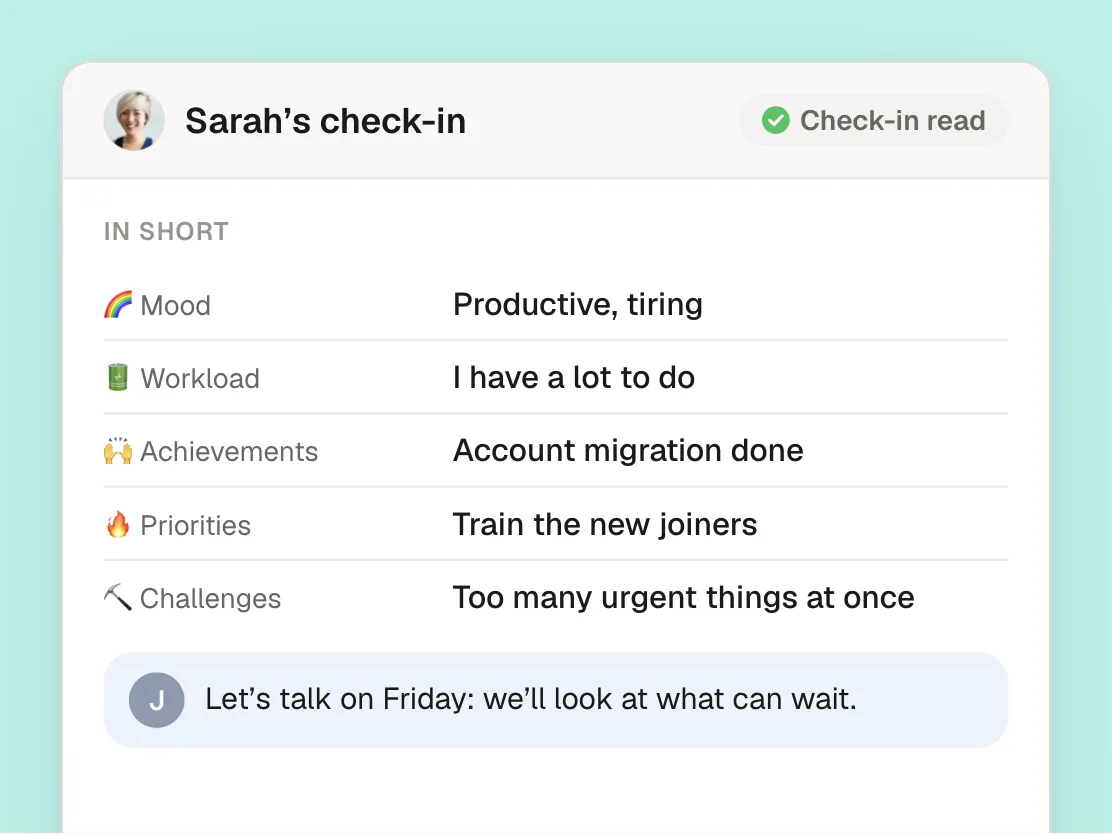
| Mood | How was your week? | 3 min |
| Achievements | What notable things have you achieved since last time? | 5 min |
| Challenges | What challenges or roadblocks are you facing? | 5 min |
| Priorities | What are your priorities until our next check-in? | 10 min |
| Other | What else would you like to add or discuss? | 5 min |
Adapt this structure to each team’s context, but keep it as your base. At the end of the 1:1, these three statements should be true:
- the manager has taken the employee’s pulse;
- manager and employee are aligned on the priorities for the coming period;
- the important topics were discussed and led to a real exchange (achievements highlighted, coaching on roadblocks, and so on).
KPIs and questions by role
Before the 1:1, managers need an overview of their team member’s performance: look at the CRM and analyse the most relevant KPIs for the role. That shows where the person gets good results and where results are less conclusive. During the 1:1, the manager can then congratulate them on their wins and look for explanations of the issues spotted, with open questions that help the rep find solutions.
Sales Development Representatives (SDR)
KPIs to check before the 1:1:
- number of new leads in the pipeline;
- number of touchpoints per lead;
- number of qualification calls done;
- number of demos booked;
- email open and engagement rates.
Recommended coaching questions:
- Tell me more about your new leads. Were they difficult to identify? Do you feel they have potential?
- What were their main objections? How did you handle them? Do you feel comfortable handling objections? Do you feel the need to strengthen this part of your sales skills?
- Did you face any particular issues with a lead this week?
- What can I do to help you qualify leads better?
Account Executives (AE)
KPIs to check before the 1:1:
- average deal lifespan in the pipeline;
- average number of days between touchpoints with a lead;
- number of demos done;
- number of won opportunities;
- number of lost opportunities.
Recommended coaching questions:
- What have you learned from the last deals you closed?
- How do you prepare for a sales meeting? Are you comfortable with this exercise?
- How could you improve your sales skills to close more deals? Do you need help from a teammate or from me on this?
- Were you able to generate new sales opportunities? If so, how did you go about it? Is this the ideal method, or is there room for improvement?
- How do you work with the support team to ensure customer satisfaction? Do you feel well supported?
- Are you struggling with one or more of your objectives?
Account Managers (AM)
KPIs to check before the 1:1:
- new sales opportunities created (upselling, cross-selling);
- number of client meetings booked;
- number of client meetings done;
- won opportunities;
- lost opportunities.
Recommended coaching questions:
- Have you faced an issue with one of your clients? How did you handle the situation?
- How do you manage the relationship with your current customers?
- Are your clients satisfied with our services?
- How could we improve our customer success?
- How do you maximise the value of each client for the company? Do you feel you have the resources to do so?
- How do you handle potential conflicts with customers? Do you feel comfortable in these situations?
- How do you split your time and effort between deals recently closed by the AEs and existing customers?
In short
Don’t think of 1:1 meetings as a checkbox on your sales manager to-do list. They are one of the most powerful management tools there is: they strengthen the manager-employee relationship, improve performance and save time. They are also a great sales coaching tool.
The engagement, motivation, performance and growth of each team member depend above all on their manager. Treat your 1:1s as the ritual with the most value for you and your team, and the return on investment will be significant. Make the advice in this guide your own, and here’s to great 1:1s and strong sales.